Rubbish Clearance London — Recycling and Sustainability
 Rubbish Clearance London takes a practical, measurable approach to sustainability. Our London rubbish clearance teams focus on reducing landfill, increasing reuse and reclaiming materials through responsible waste clearance in London properties. We have set a clear recycling percentage target to guide every job: by 2028 we aim to divert 75% of collected materials away from landfill into recycling and reuse streams. That target shapes our day-to-day planning, from crew briefings to vehicle routing and handover paperwork for each collection.
We work closely with local transfer stations and material recovery facilities across the city to ensure that separated waste goes to the right place for processing. Our London waste clearance operations route loads to nearby transfer stations to keep emissions low and turnaround fast — using borough-friendly hubs where sorting and consolidation are done before downstream recycling. This includes coordination with north, south and east London transfer sites and specialist reprocessing centres for construction, garden and bulky waste.
 Strong charity partnerships are central to our reuse strategy. Where items are fit for reuse — furniture, small household goods, textiles and working appliances — our rubbish removal in London includes secure, documented donations to local charities and social enterprises. We partner with community organisations and borough-level reuse networks so that usable items benefit people in the same neighbourhoods where they were collected. This approach reduces waste tonnage and supports local social value outcomes.
How boroughs separate waste and how we support it
London boroughs take slightly different approaches to separation — some run separate food waste and paper collections, others operate a mixed recycling box or sack system. We design each job to match the local scheme: where a council asks for separate glass, paper, plastic and food streams we sort on-site and load accordingly; where boroughs accept dry mixed recycling we consolidate loads to match transfer station acceptance criteria. Our teams are trained to recognise local rules and to label loads so council and contractor partners can accept them without delay.![A large pile of mixed waste materials is situated on a residential pavement, consisting of broken concrete slabs, wooden planks, flattened cardboard boxes, and plastic bags, some of which are blue and white. The debris appears to be accumulated from a clearance or renovation, with fragments of masonry, fabric, and packaging scattered unevenly. The pile is positioned near a house with beige exterior walls and two small, white-framed windows visible in the background. The surrounding area includes a section of garden with small bushes and landscaped plants, separated from the pavement by a low hedge. The waste is unorganized, with larger pieces leaning against each other and smaller debris spread across the ground, indicating a typical rubbish removal scenario in [POSTCODE] or the local area served by Rubbish Clearance London, which offers services for waste clearance and disposal within the [TOWN] region. The overall scene is brightly lit, suggesting daylight during a clear day, capturing the typical appearance of domestic rubbish awaiting collection.](/pub/_photos/rubbish/f1778322976.jpg)
What we recycle and reuse
We handle a wide range of materials that are commonly encountered across London clearances. Typical collections include:- Bulky household items (sofas, mattresses, wardrobes) — assessed for refurbishment or donation
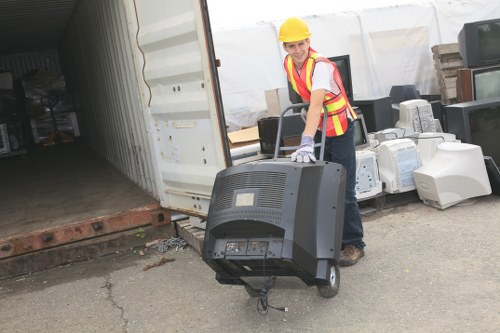
- Electronics and WEEE (TVs, PCs, printers) — separated and sent to authorised WEEE processors
- Metals, timber and hardcore from small building clearances — routed to specialist recyclers
- Textiles and clothing — diverted to local textile charities or fabric recycling streams
- Garden waste and green materials — sent to composting and anaerobic digestion where accepted
We also treat hazardous items with care, ensuring that batteries, paint and oils are transferred to proper facilities rather than being mixed with general waste. Our documentation records where each material goes, enabling transparent reporting on recycling rates.
Low-carbon vans and smarter logistics are a major part of how we reduce environmental impact from rubbish removal in London. Our fleet includes a growing number of electric and hybrid vans and vehicles compliant with the latest emissions standards. We apply route optimisation and load consolidation to minimise mileage and carbon emissions. On dense inner-London jobs we frequently switch to smaller, low-emission vehicles to make multiple, targeted trips rather than running oversized trucks that contribute to congestion and pollution.
 Beyond vehicles, our operational measures include crew training in materials separation at source, use of reusable moving equipment to avoid single-use plastics, and regular audits of disposal pathways. We track tonnage by stream and report progress against our recycling percentage target on an internal dashboard, so each branch can see improvements and identify opportunities to increase reuse and recycling.
 Community engagement, charity partnerships and transparent reporting all help make our mission real. We support local collection events, donate serviceable items to community centres, and frequently work with borough reuse hubs to keep items circulating locally. Our aim is to deliver efficient and compliant waste clearance services while helping London boroughs meet their own sustainability commitments.
Why choose our waste clearance London services
Choosing our waste clearance services means selecting a partner focused on resource efficiency. We balance operational practicality with environmental purpose: vetting transfer stations, confirming charity recipients, using low-carbon vans, and pursuing a measurable recycling target. Every crew is empowered to make decisions that increase reuse and reduce landfill, and we maintain records to demonstrate where materials are sent.Our promise
We promise continual improvement. Our ambition is to exceed the 75% diversion goal over time as infrastructure and materials markets evolve. We will continue expanding partnerships with charities, increasing utilisation of low-emission vehicles and evolving our transfer-station network to keep London clearer — and greener.Rubbish Clearance London remains committed to practical sustainability: measurable targets, local transfer stations, charity reuse, and a low-carbon fleet are the pillars of our approach. By aligning our operations with borough collection schemes and supporting community reuse networks, we help the city move toward a circular, low-waste future.